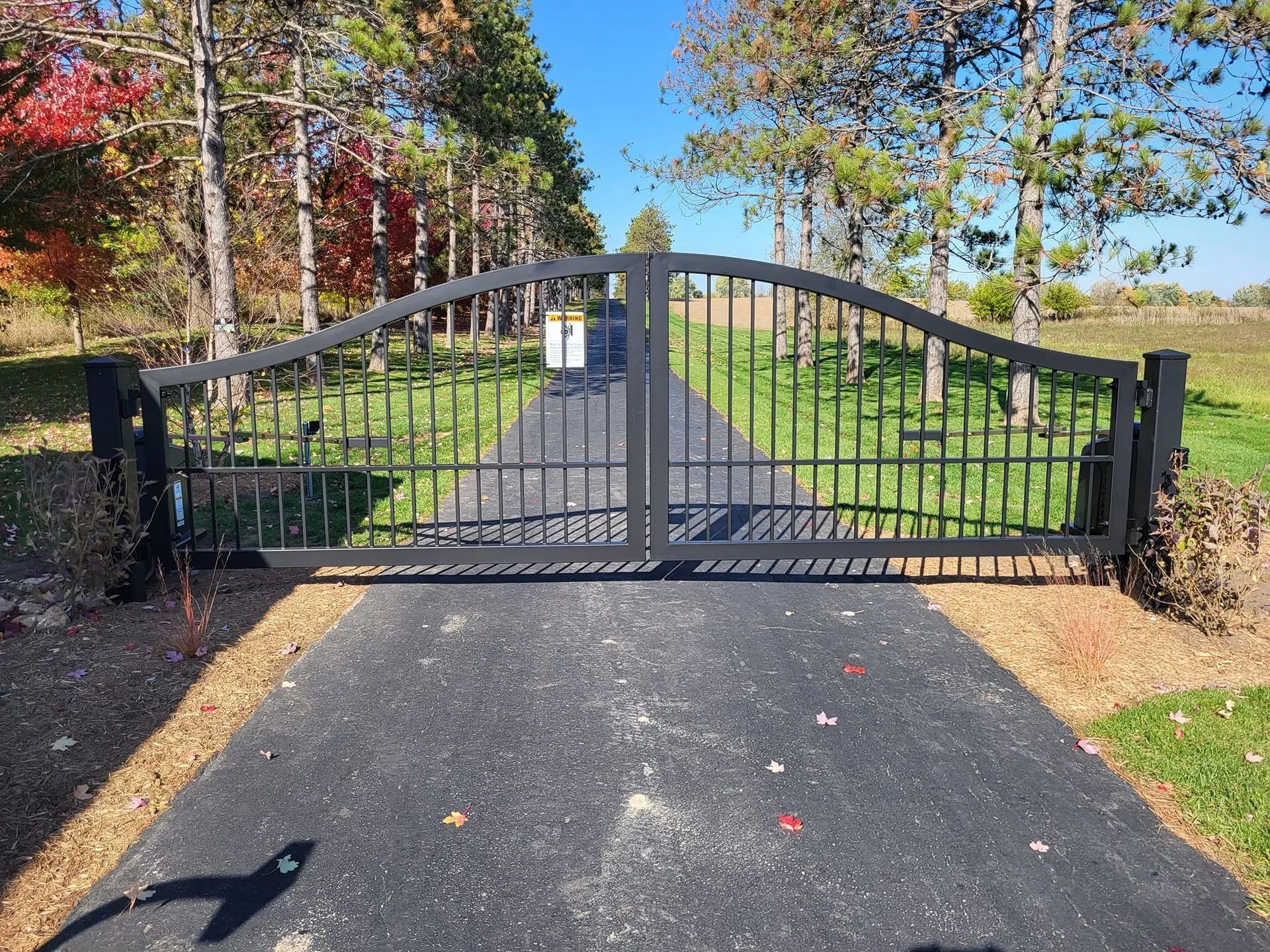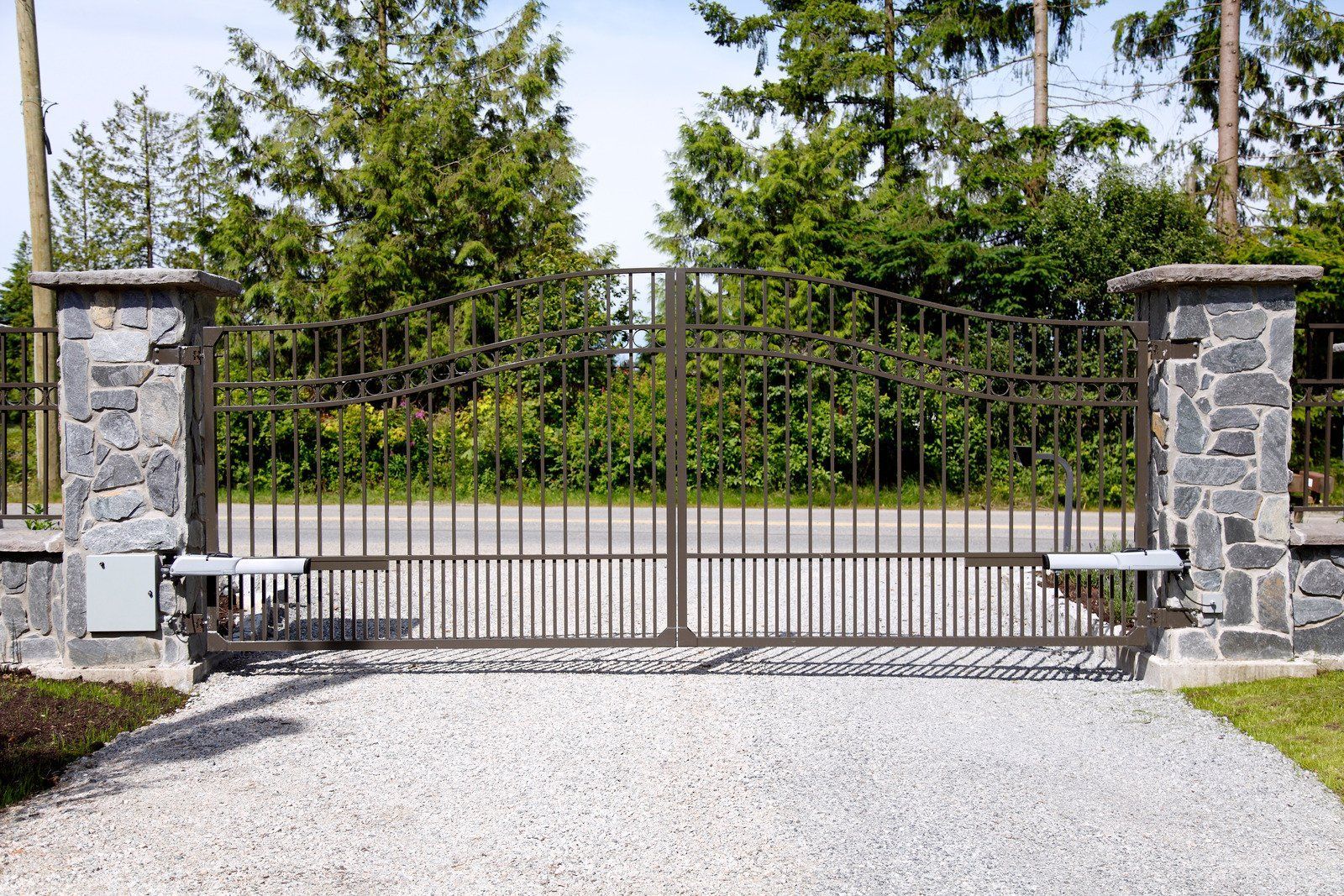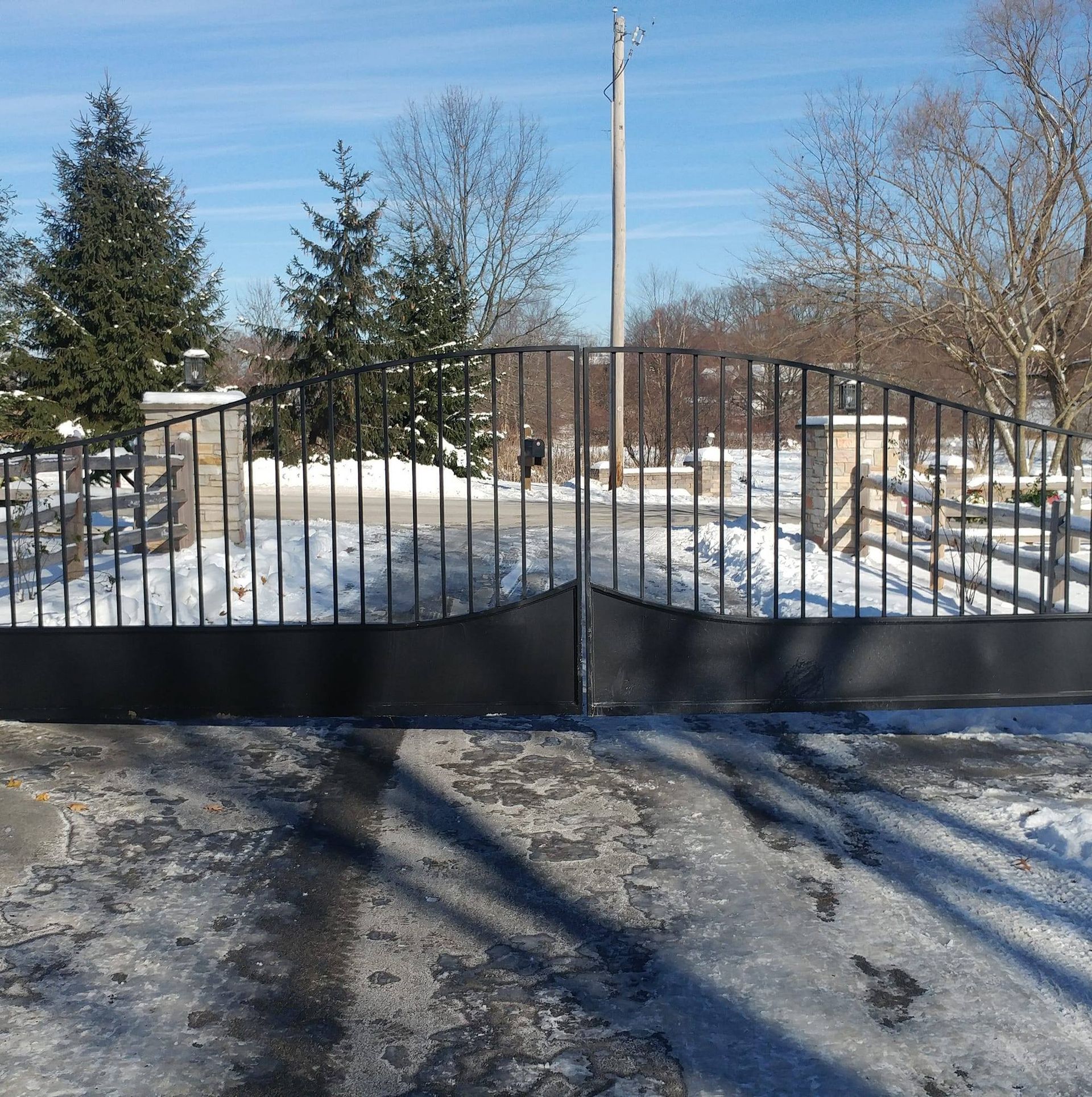
QUICK ANSWER: A single swing gate uses one panel that swings fully open across the driveway width, while a dual swing gate splits the same opening into two smaller panels that meet in the middle. Single gates work best on openings up to roughly 14 feet, where one panel stays within standard hinge and operator weight limits. Dual gates become the more practical choice past about 16 feet, since splitting the span in half cuts the swing arc and the load on each hinge post roughly in two. A sloped or tight driveway can push the decision either way, since both designs still need clear ground to swing through.
Stand at an 18-foot driveway opening with a tape measure and the math gets real fast. A single panel that wide needs almost 18 feet of clear space to swing open on one side of the driveway. Put a parked car, a slope, or a mailbox anywhere in that path, and the gate either stops short or drags across the gravel every time someone opens it. That one measurement — how far a panel actually has to travel before it clears the driveway — is usually what pushes a homeowner from a single-panel design toward a split one, or the other way around.
Looks matter less here than people assume. A single gate reads differently than a dual one, sure, but the real decision comes down to geometry, what the hardware is rated to handle, and how the ground under the gate moves through the year.
How the Swing Arc Actually Works
A swing gate pivots on a hinge post and travels through an arc until it lands flush against the fence line or a stop. The panel's width sets that arc's radius. A single 14-foot panel needs 14 feet of open space to swing all the way. Split that same 14-foot opening into two 7-foot panels instead, and each one only needs about 7 feet of clearance.
Half the arc, on each side. That difference shows up most on driveways where the swing path crosses a walkway, runs close to a garage door, or sits near a drop-off. A split gate opens into a tighter footprint simply because neither panel has to travel as far. On a wide-open, flat driveway with nothing in the way, that clearance edge stops mattering as much, which is a big part of why single panels are still common on properties with generous frontage.
Weight and leaf limits factor in too. Standard swing gate operators are commonly rated for panels up to around 14 feet and 600 pounds. Build a single panel out to 16 or 18 feet to span a wide driveway, and it starts pushing past what a standard operator and hinge assembly were built to carry. That's one reason installers lean toward splitting wider openings into two panels instead of stretching one leaf beyond its rating.
Single Swing Gates: Where They Make Sense
One panel, one hinge post, and in most cases one operator. That's the whole appeal of a single swing gate — it's simple by design.
Narrower Openings
Driveways in the 10-to-14-foot range are a natural fit. The panel stays within typical leaf weight and width ratings, the swing arc is short enough to manage, and there's no second panel that needs to line up with the first.
A Cleaner Sightline
With no center meeting point, a single gate closes as one continuous piece. Wrought iron and ornamental designs especially benefit here — a pattern or a scroll motif can run edge to edge without a seam cutting through the middle of it.
Fewer moving parts, too. One hinge set, one panel, typically one operator — nothing extra to fall out of sync over time. But the tradeoff is space. A single panel wide enough to span a two-car driveway needs a matching stretch of clear ground to swing through, and if that room isn't there, something has to give: either the opening gets narrower than the homeowner wants, or the design shifts to a dual configuration.
Dual Swing Gates: Where They Make Sense
Split the opening into two panels that meet at the center when closed, each one pivoting on its own hinge post, and you get a different set of tradeoffs entirely.
Wider Openings
Past roughly 16 feet, splitting the span becomes the more practical route. Two 8-foot panels each sit comfortably within standard operator and hinge ratings, where one 16-foot panel would be riding right at the edge of what typical hardware handles.
Load Spread Across Two Posts Instead Of One
A wide single panel puts its full weight and wind load on one hinge post. Split that panel in two, and each post only carries about half. On a property where footings sit in soil that shifts through the seasons, that difference isn't small.
The traditional estate look also plays a role, independent of the width math entirely — plenty of homeowners choose the paired-panel style on a driveway that would technically fit a single gate, just because they prefer how it looks closed. What they give up is simplicity: two hinge posts, two panels, and depending on the automation setup, potentially two operators that need to stay timed so both sides swing together rather than at slightly different speeds.
TIP: Walk the full swing arc of any gate design before committing to it, not just the closed footprint. Mark where the open panel — or panels — will actually land relative to parked cars, walkways, and slopes. A gate that measures fine on paper can still bind against something in its path once it's swinging for real.
Driveway Slope and Ground Conditions
Width isn't the only variable at play. A driveway that slopes toward the street changes how much ground clearance a swinging panel needs, and splitting the gate into two smaller panels doesn't shrink that requirement — each leaf still has to clear the grade change along its own arc.
Ground movement over the seasons matters here too. Freeze-thaw cycles through winter and into spring shift the soil around post footings in this part of the country, and that movement can gradually throw a gate's alignment off if the footing wasn't set to handle it. A single gate concentrates that stress on one hinge post. Split it into two, and the stress spreads out — worth weighing on a driveway where the soil is known to heave or settle unevenly.
Uneven grade across the width of the opening is a separate issue from slope along the driveway's length, and it's easy to miss on a quick walk-through. If one side of the opening sits noticeably higher than the other, a single panel spanning both sides has to be built to account for that whole grade change at once. Two shorter panels, each anchored to a more consistent local grade, sometimes fit that situation more cleanly.
Automation and Long-Term Maintenance
Both configurations can be automated, but the setup underneath looks different. A single gate typically runs on one operator arm. A dual gate usually needs two — one per panel — programmed to open and close together, sometimes with a slight stagger built in so the panels don't collide at the center on the way shut.
That second operator means a second motor, a second set of safety sensors, and one more point where wiring or a control board could eventually need attention down the road. That's not an argument against dual gates; plenty of driveways are wide enough that splitting the panel is the structurally sound call regardless of the extra hardware. It's just a real difference in how many parts are working together every time the gate cycles.
Hinge wear tends to play out differently between the two as well. A single gate's hinge post carries the full cantilevered weight of the panel on every swing, which puts steady strain on that one connection. Two hinge posts on a dual gate each carry a lighter share, which can mean less wear piling up in any single spot over years of daily use. Either way, hinge and hardware checks stay part of the routine — the difference is where the load lands, not whether it needs attention at all.
Aesthetics and Property Layout
Beyond the mechanics, the two designs read differently once installed. A single gate presents as one unbroken plane when closed — useful for a continuous pattern, a solid privacy panel, or a monogram that shouldn't get interrupted by a seam. A dual gate's center meeting point stays visible even in a perfectly symmetrical design, which is part of why it reads as the more formal, traditional option on longer or more prominent driveways.
Property layout plays into it, too. A circular or curved approach often favors a dual gate, since the two panels can angle slightly differently to follow the curve — a single flat panel would have to span a straight chord across it instead. A straight, perpendicular driveway doesn't run into that constraint either way.
WARNING: Don't assume a wider opening just means "make the single panel bigger." Pushing one leaf past standard weight and width ratings for its hinge hardware and operator invites sagging, slower operation, and premature hinge post wear. A dual configuration exists partly to keep each panel inside the range the hardware was actually built to handle.
Matching the Gate to the Driveway, Not the Other Way Around
The most common misstep here isn't picking the "wrong" style. It's picking a configuration first and then working backward to make the driveway fit it. A driveway's width, slope, surrounding obstacles, and soil behavior are fixed; the gate design should respond to those conditions rather than the reverse. A site walk-through that measures the actual swing path, checks the grade across the full opening, and accounts for what's parked or planted nearby tends to hold up a lot longer than a style chosen first and adjusted around later.
Frequently Asked Questions
How wide does a driveway opening need to be before a dual swing gate makes more sense than a single one?
Most installers consider a dual configuration once the opening passes roughly 16 feet, since a single panel that wide starts exceeding standard hinge and operator ratings. Available swing clearance can shift that threshold either direction.
Can a single swing gate be widened later if the driveway changes?
Usually not without replacing the panel and re-evaluating the hinge post and operator, since both were sized for the original width. Converting to a dual configuration is often more practical than building an oversized replacement.
Do dual swing gates need two separate openers, or can one opener run both panels?
Most installations use two separate operators, one per panel, timed to open and close together. A single operator driving both panels through a shared linkage exists in some setups, but it is far less common.
Is a dual swing gate harder to keep aligned than a single gate?
Slightly. A dual gate adds a point of coordination, with two hinge posts and two panels that must meet evenly at the center. Routine hinge and hardware checks keep either configuration properly aligned over time.
Does a sloped driveway rule out one type of swing gate over the other?
Not automatically, but it changes how much ground clearance each panel needs. A driveway with a grade change across its width often suits a dual gate, since each shorter panel follows a more consistent grade.
Can a pedestrian walk-through gate go in next to either a single or dual swing driveway gate?
Yes. A separate pedestrian gate typically works alongside either configuration, since it operates independently of the driveway panels. It just needs placement that keeps it clear of the vehicle gate's swing path and hinge hardware.
Letting the Driveway Decide Which Gate Works Best
Every driveway carries its own mix of width, slope, soil, and nearby obstacles, and that mix decides whether a single panel or a paired set will hold up over time. The right choice keeps hinges within their ratings, gives each leaf enough room to swing freely, and handles seasonal ground movement without drifting out of alignment. Measuring the real swing path first, rather than choosing a style from a photo, is what keeps the gate working smoothly long after installation.
At American Gate Entry Systems
in Griffith, IN, we have spent 30
years installing and servicing
driveway gates
across Northwest Indiana, where freeze-thaw cycles test every footing and hinge post. That time has shown us that the best results come from letting the property itself guide the design. When the opening, grade, and hardware all line up, a single or dual gate simply opens, closes, and meets its stop the same way on the thousandth cycle as on the first.